

I am a physiological and evolutionary ecologist dedicated to understanding the phenotypic adaptations that allow organisms to navigate and persist in their environments. My research sits at the intersection of experimental biology, macroevolution, and computational modeling.
I seek to explain why species live where they do by integrating micro- and macro-evolutionary data with cutting-edge tools in historical biogeography and niche modeling. By combining experimental data with mechanistic biophysical models, I aim to pinpoint the precise factors—whether physiological, morphological, or behavioral—that dictate species distributions and their vulnerability to a changing climate.
Research Lines
Macroevolution of Phenotypes and Ranges
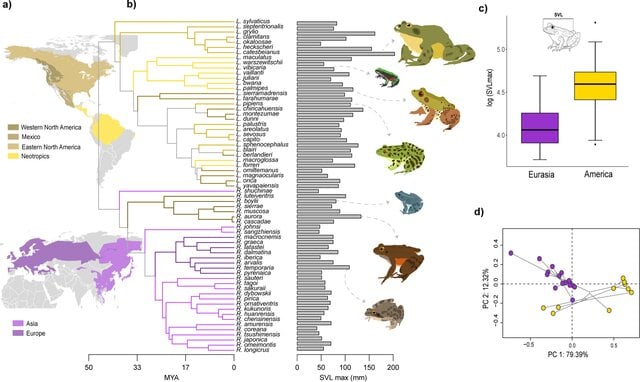
I investigate how species’ traits and climatic niches evolve over deep time using phylogenetic comparative methods. My work explores the links between biogeographic history, niche evolution, and lineage diversification. A significant focus of this research is testing the universality of “ecogeographical rules” (such as Bergmann’s and Allen’s rules).
By studying parallel radiations of frogs (Rana and Lithobates), I have demonstrated that these rules are often context-dependent; for instance, while some clades follow the water conservation hypothesis, others show no clear trend. This suggests that the macroevolutionary trajectories leading to current ranges are shaped by clade-specific constraints rather than universal climatic laws.
Microevolution across Environmental Gradients
A central goal of my research is understanding how populations of the same species cope with contrasting climates along elevational and environmental gradients. Through experimental measurements of thermal tolerance, acclimation potential, and locomotion sensitivity, I explore the capacity for local adaptation.
My findings in temperate amphibians (e.g., R. temporaria) indicate that thermal tolerance often varies little with elevation. Instead, behavioral thermoregulation acts as an obligatory buffer. This research highlights that strong tradeoffs between performance and specialization, alongside behavioral buffering, can hinder microevolution, making populations across all elevations highly vulnerable to rapid climate warming.
Range Margins and Distributional Limits
Understanding what stops a species at its geographic edge is critical in an era of unprecedented climate change. My research combines mechanistic and correlative species distribution models (SDMs) to identify the specific processes—such as thermal or hydric stressors—that define range margins.
I have found that many species, particularly Iberian amphibians, are not tracking their climatic niches fast enough to keep pace with warming, leading to a shift in their realized climatic niches rather than their geographic ranges. By coupling biophysical models with ecological data, I can identify specific range-limiting factors, such as maximum pond temperatures reaching the critical thermal limits of larvae, which ultimately dictate the persistence of a species at its distribution margin.
Advances in Mechanistic Niche Modeling
I develop and refine mechanistic (biophysical) niche models to move beyond simple correlations. One of my primary contributions is the development of a framework for modeling thermal and hydric constraints on developing eggs in the soil.
By integrating Dynamic Energy Budget (DEB) theory, I can model development and metabolic heat generation simultaneously. This allows for a granular understanding of how environmental dryness and temperature affect life stages that are often overlooked in traditional modeling, such as the egg or juvenile stages. These tools are now publicly available (e.g., via the NicheMapR framework) to facilitate more accurate predictions of climate change impacts.
Metabolic Ecology & Life-History
I study the mechanisms behind phenotypic responses at different levels of biological organization. This includes investigating how increases in metabolic rates associated with warming vary depending on specific behavioral strategies, such as sheltering.
I am particularly interested in the role of body size and physiology in ecological interactions. My recent work explores how these traits evolve in association with climate and how their lack of adaptation can exacerbate the impacts of global change. This metabolic perspective is essential for understanding the energetic costs of survival in increasingly stressful environments.
Open Science & Reproducibility
I am a firm believer in Open Science. Since the beginning of my career, I have deposited all research data in public repositories like Dryad and made my analysis code available via GitHub and Zenodo. I actively promote reproducible science by developing and teaching sessions on the use of R, version control (Git), and environments like renv.