

This paper is the result of the master thesis of Katerina Sioumpoura, a former master student of mine at CIBIO (University of Porto), co-supervised with Antigoni Kaliontzopoulou and Neftalí Sillero. Congratulations, Katerina!
How much an ectotherm can do depends on its body temperature, and body temperature depends on the environment. To predict how populations will respond to climate change, we need to know how variation in thermal physiology and body size among individuals translates into performance under realistic conditions, not only in the lab.
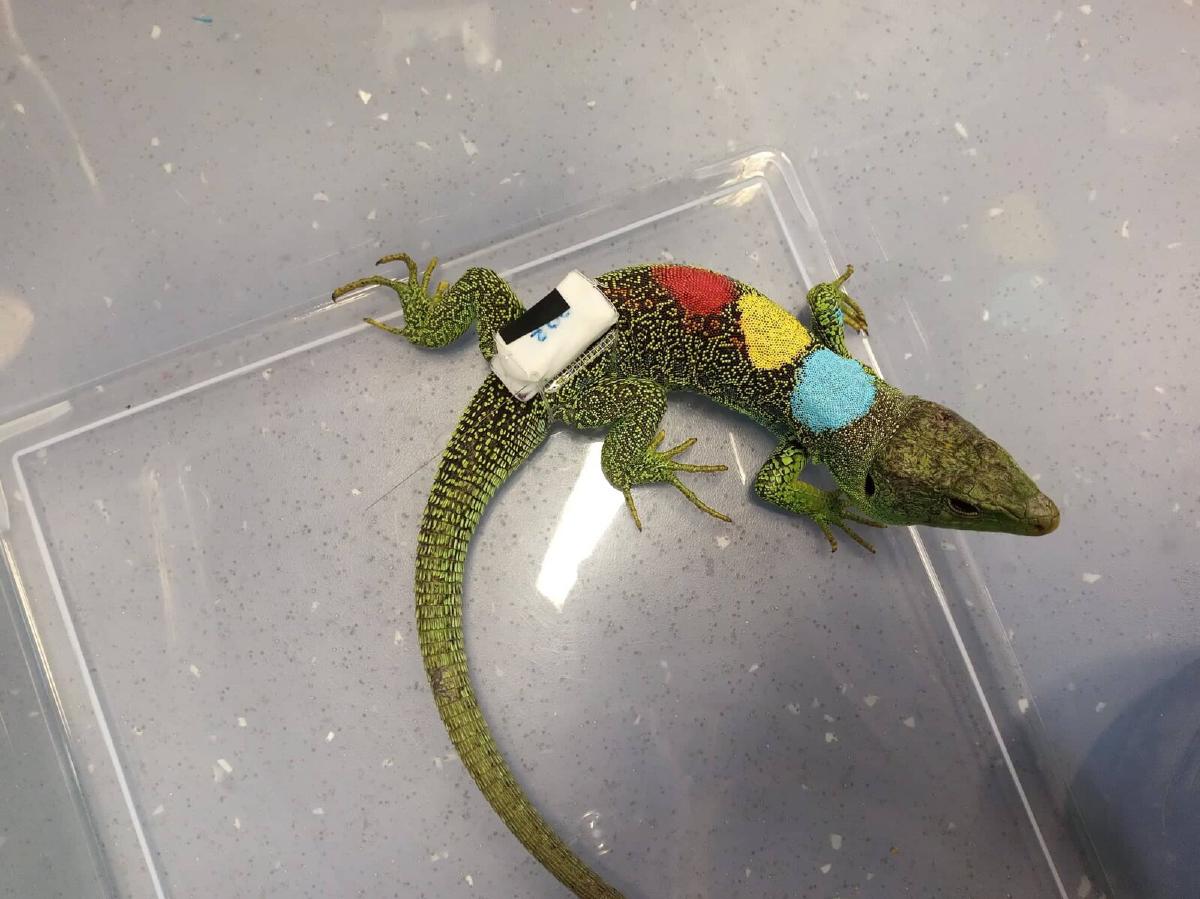
To address this, we combined fine-scale biologging with individual-level mechanistic niche modelling in ocellated lizards (Timon lepidus). We released adult males in four semi-natural mesocosms (10 × 10 m enclosures with rocks, bushes and open ground) and equipped each lizard with a small biologger attached to the base of the tail. The loggers recorded tri-axial acceleration ten times per second, along with temperature, humidity and light.
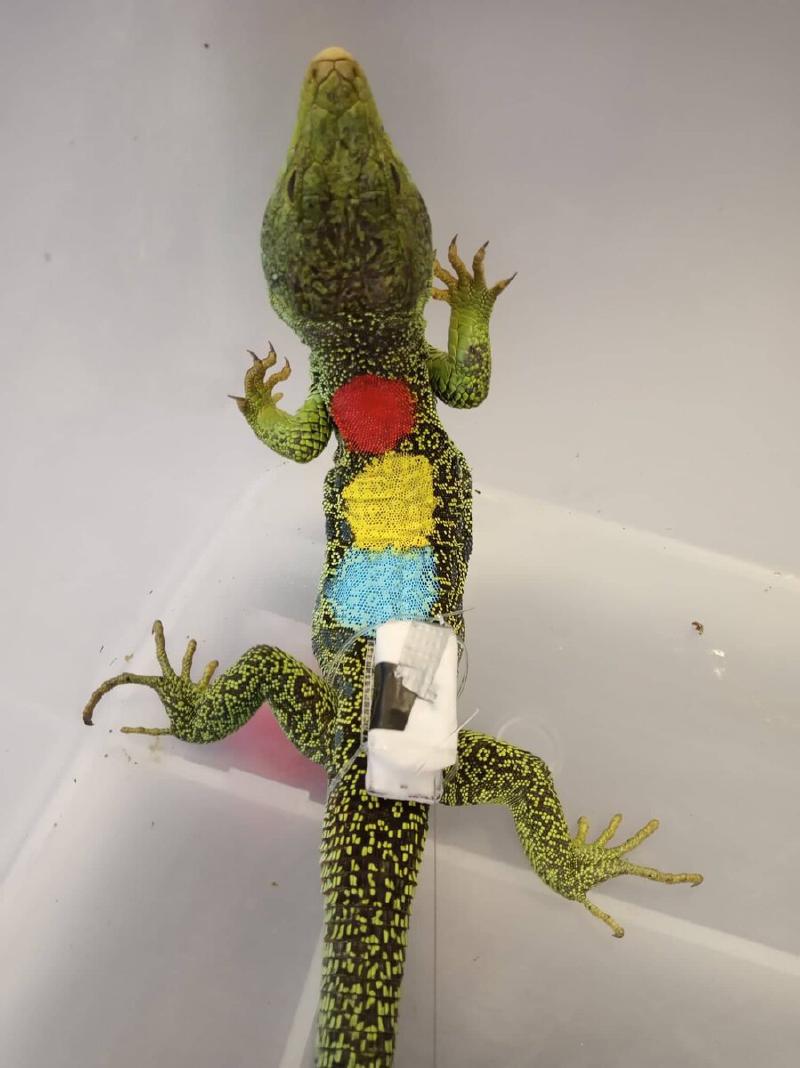
From the accelerometer data we classified when each lizard was moving and when it was immobile. In parallel, we built a mechanistic model for each individual with NicheMapR, using the microclimate model (calibrated with dataloggers placed in the mesocosms) and the ectotherm model, to predict continuous body temperatures. Combining these predictions with individual thermal performance curves (TPCs) of locomotor performance, we could link body temperature to movement, test for evolutionary trade-offs, and simulate mobility windows under +2 °C and +4 °C warming scenarios.

Individuals fell along a ‘specialist–generalist’ continuum of thermal strategies. Some reached higher locomotor performance, but only within a narrow range of temperatures. Others performed less well at their peak but could stay mobile across a broader range. We found no support for the ‘hotter-is-better’ hypothesis, since the optimal temperature and maximum performance were not correlated.
Body size did not affect movement patterns under current conditions. However, the warming simulations showed that all individuals gained mobility time, and that larger individuals may gain disproportionately more under extreme warming (+4 °C), possibly because their higher thermal inertia buffers them. Specialists, especially small ones, gained mobility under mild warming, but those gains levelled off at higher temperatures.
Overall, subtle differences in thermal physiology and body size among individuals can lead to differences in locomotor performance and mobility. Integrating physiological, behavioural and microclimatic data gives us a powerful way to predict how climate change may reshape the spatial and temporal niches of ectotherms.
Link to the paper: https://besjournals.onlinelibrary.wiley.com/doi/full/10.1111/1365-2656.70376